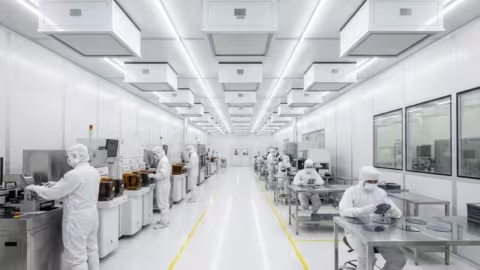
As a result, international companies are increasingly required to understand not only where they manufacture their products, but also how their supply chains are connected to the geopolitical interests of different governments.
Asia’s Economic Outlook Remains Uneven
Despite the region’s importance to global trade, economic conditions across Asia are far from uniform. Some economies continue to benefit from manufacturing investment and expanding technology demand, while others are struggling with currency pressure, inflation and weaker financial market sentiment.
Indonesia provides an example of these challenges. The country’s central bank unexpectedly resumed raising interest rates this week, increasing its benchmark rate by 25 basis points to 6.0%.
The decision was intended to support the weakening rupiah and maintain price stability. A weaker currency can create additional pressure on an economy by making imported goods and essential production inputs more expensive. It can also complicate financial planning for companies that depend on international suppliers or borrow in foreign currencies.
Higher interest rates may help stabilise the currency, but they can also increase borrowing costs for households and businesses. Companies considering new factories, equipment purchases or expansion projects may become more cautious when financing becomes more expensive.
The situation highlights an important distinction between Asia’s long-term growth potential and the short-term economic pressures facing individual countries.
Financial markets have also reflected this uncertainty. Hong Kong’s Hang Seng Index was projected to open approximately 1.7% lower, while Japan’s Nikkei 225 was expected to decline by around 0.5% as weakness in technology stocks spread across regional markets.
These movements suggest that Asian equities remain sensitive to developments in the global technology sector, particularly when investors reassess the valuations of companies connected to artificial intelligence and semiconductor manufacturing.
For economies heavily dependent on exports, fluctuations in international demand can have a particularly significant impact. Technology manufacturers, electronics suppliers and shipping companies may experience changing order volumes as businesses adjust their investment plans and reassess the risks associated with international trade.
Asia remains one of the world’s most important engines of economic growth, but its performance increasingly depends on developments outside the region as well as domestic conditions.
Supply Chains Face a New Era of Uncertainty
One of the most important consequences of growing competition between Washington and Beijing is the transformation of global supply chains.
For decades, international businesses generally operated under the assumption that globalisation would continue expanding. Companies could manufacture products in countries offering competitive labour and production costs, source components from different regions and sell finished goods in international markets with relatively predictable trade conditions.
That model is becoming more complicated.
Export restrictions, technology controls, tariffs and geopolitical disagreements are forcing businesses to reconsider where they source materials and manufacture products. Industries such as semiconductors, telecommunications, artificial intelligence and advanced manufacturing are particularly exposed because their operations often depend on specialised technologies and suppliers located across multiple countries.
Some companies are responding by diversifying production beyond China, establishing additional manufacturing capacity in countries such as Vietnam, India, Thailand and Indonesia.
This strategy, often associated with the concept of China Plus One, allows businesses to maintain existing operations in China while developing alternative production locations. The objective is not necessarily to abandon the Chinese market, but to reduce dependence on a single manufacturing destination.
However, diversification is not always straightforward. Establishing new facilities requires investment, qualified workers, reliable infrastructure and access to supporting suppliers. Companies must also consider local regulations, logistics costs and the time required to build efficient production networks.