The Las Vegas Grand Prix was supposed to be Formula 1’s victory lap — a glittering night race down the Strip, run under the lights of the most famous boulevard in the world, with a newly crowned world champion in Kimi Antonelli and a constructors’ title already sealed by Mercedes. Instead, the week has been dominated by a single, unglamorous subject: rain. Lando Norris has warned that the current wet-weather tyres are not ready for Las Vegas, calling the prospect of running there in the rain a serious concern. Max Verstappen reported recurring balance and power deployment issues in his Red Bull during wet practice. Lewis Hamilton posted only the sixth-fastest time in rain-affected practice as Ferrari worked through its setups. And in the background, Pirelli has imposed a 27-lap maximum tyre stint for the Qatar Grand Prix to prevent structural failures. The sport’s most spectacular race is now also its most anxious one, and the anxiety is entirely justified.
To understand why rain matters so much in Las Vegas, it helps to understand what the circuit actually is. The Las Vegas street circuit is not a purpose-built racetrack. It is a temporary course laid out on public roads, running past the Bellagio, Caesars Palace and the MSG Sphere, with long straights where cars reach extraordinary speeds and tight corners where they must brake from those speeds in the space of a few hundred metres. In the dry, it is a spectacular challenge. In the wet, it is a different proposition altogether. Street circuits have no run-off areas, no gravel traps, only walls — and when a car loses grip at 300 kilometres per hour on a wet street, there is nowhere for it to go but into the barrier. The drivers know this. Norris’s warning is not a complaint. It is a professional assessment from a man who has raced in the wet at Interlagos, at Spa and at Suzuka, and who believes the tyres Pirelli has brought to Las Vegas are not up to the job.
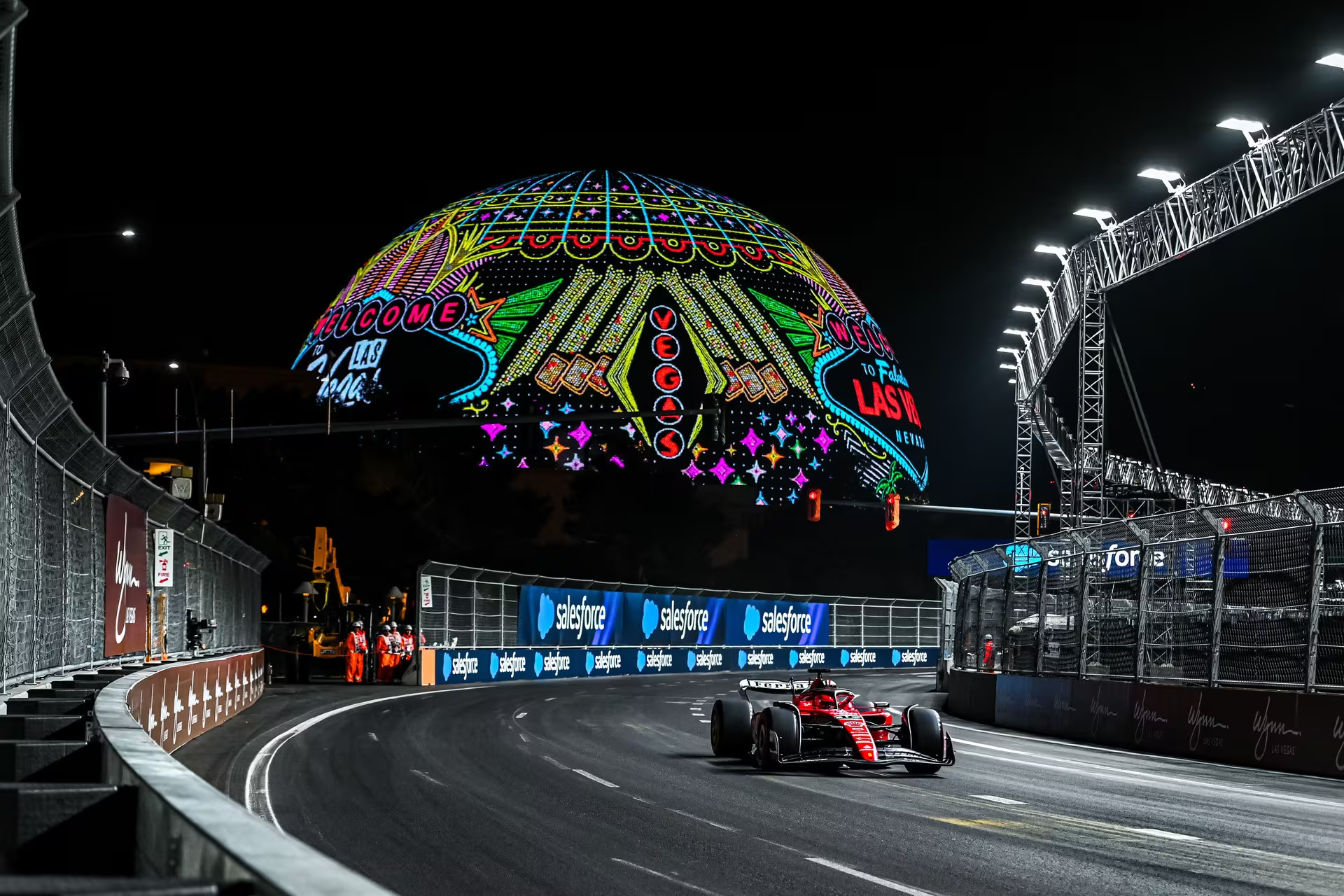
The tyre problem is the heart of the matter. Formula 1’s wet-weather tyres have been a source of frustration for years. The full wet tyre, designed for heavy rain, is so rarely used that drivers and teams have little experience with it, and the intermediate tyre, designed for damp conditions, is often asked to do a job it was not designed for. Pirelli has worked to improve both, but the fundamental problem remains: a tyre that must work in standing water, on a cold street circuit, at night, in November, is being asked to perform in conditions that no laboratory can fully reproduce. The 27-lap maximum stint imposed for Qatar is a separate issue — a response to concerns about structural failures over long runs — but it points to the same underlying tension. The tyres are the only part of the car that touches the ground, and when they are the subject of two separate safety interventions in the same week, the sport has a problem that goes beyond one race.
Verstappen’s struggles in practice add another layer to the story. The four-time world champion, who started 21st in Brazil and drove through the field to second in a damaged car, is the driver least likely to be rattled by difficult conditions. His reports of balance and power deployment issues in the wet suggest that the problem is not driver confidence but car behaviour — that the Red Bull, like the other cars on the grid, is struggling to find grip and consistency when the track is wet. Hamilton’s sixth-fastest time tells a similar story from a different team. Ferrari arrived in Las Vegas with setups prepared for the rain, and still found itself off the pace. When the two most successful drivers of the modern era are both struggling in the same conditions, the conditions are the story.
There is a brighter thread in the Las Vegas week, and it comes from the support races. Alisha Palmowski claimed her seventh F1 Academy pole of the season in Las Vegas, by the largest qualifying margin in series history, a performance that underlines her dominance of the championship and the growing strength of the series as a pathway for young female drivers. The F1 Academy, launched to give women a genuine route into top-level motorsport, has produced exactly the kind of story the sport needs: a young driver, winning races, setting records, and doing it on the biggest stage Formula 1 can offer. Her pole position in Las Vegas is a reminder that the weekend is about more than the main event, and that the future of the sport is being written in the support races as well as in the Grand Prix itself.
The championship context adds a strange quality to the weekend. With Antonelli already crowned the youngest world champion in history and Mercedes having sealed the constructors’ title, the Las Vegas Grand Prix is, in competitive terms, a race with nothing at stake — and that makes the rain debate more important, not less. When a championship is on the line, drivers accept risks they might otherwise refuse. When it is not, the question of whether to race in dangerous conditions becomes sharper. The sport’s governing body, the FIA, will have to make a decision if the rain arrives as forecast, and that decision will be judged not by the spectacle it produces but by the safety it guarantees. Formula 1 has learned, through painful experience, that the worst outcome is a race that should never have started.
For now, the teams wait, the forecast is watched, and the drivers prepare for a race that could be either a classic or a cautionary tale. Las Vegas was meant to be Formula 1’s showpiece — the race that proved the sport could conquer America, could fill the Strip, could turn a Grand Prix into an event that transcends motorsport. It may still be all of those things. But the week has been a reminder that for all the neon, the Sphere and the spectacle, Formula 1 is still a sport decided by grip, by tyres and by the weather — and that no amount of glamour can change the physics of a wet street at night. The rain has not yet fallen. The worry already has.
Sources: HeadlinesBriefing Sports, 16 November 2026; RadioGuide Sports News, 20 November 2026.