
LeBron James has moved past Jason Kidd into third place on the NBA’s all-time assists list, a milestone he said he never expected to reach. It is a sentence that deserves to be read twice, because it contains two facts that should not be possible at the same time. The first is that LeBron James, at forty-one years old, in his twenty-fourth NBA season, is still playing at a level where he passes legends on the all-time lists. The second is that he did it in assists — the statistic that measures unselfishness, vision and the ability to make teammates better — which has always been the most underrated part of his game. The scorer gets the headlines. The passer gets the record, and LeBron James now owns one of the greatest passing records in the history of the sport.
The assists list is a roll call of the greatest playmakers who ever lived. At the top is John Stockton, whose record has stood for decades and may never be broken. Second is Jason Kidd, the point guard who defined an era of pass-first basketball and who has now been passed by a player who was never supposed to be a point guard at all. LeBron James is six feet nine inches tall, built like a power forward, and has spent his career scoring more points than anyone in NBA history. That he is also now the third-greatest passer in the history of the league is a fact that breaks every category the sport has for describing its players. He is not a scorer who passes. He is not a passer who scores. He is both, at a level that no one else has ever reached, and the assists record is the proof.
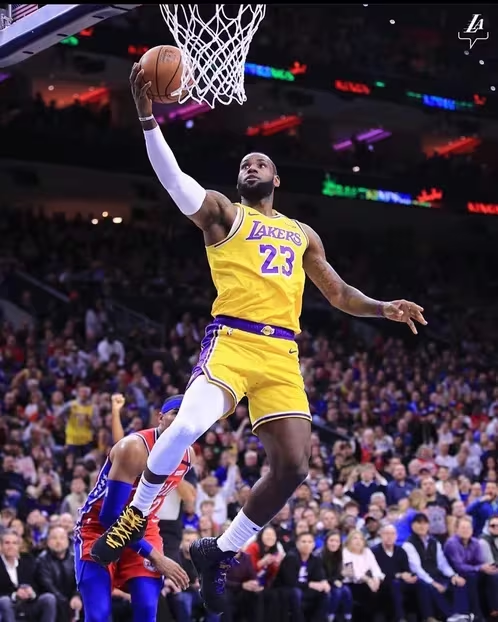
What makes the milestone remarkable is the context in which it was achieved. LeBron James is not a young player padding his statistics in garbage time. He is forty-one, playing for a Lakers team that is 11-2 with the best record in the league, winning seven straight games behind Luka Doncic’s scoring and LeBron’s own all-around brilliance. He is still the player his team turns to when the game is on the line, still the player who defends the opponent’s best scorer, still the player who makes the pass that wins the game. The assists record did not come in a farewell tour. It came in the middle of a season in which his team is contending, and in which he remains one of its most important players. That is what longevity actually looks like — not survival, but relevance.
The comparison with Jason Kidd is instructive, because Kidd was the purest point guard of his generation. He could not shoot like LeBron, could not score like LeBron, and could not dominate a game physically the way LeBron does. What Kidd could do was see the floor — anticipate where his teammates would be, deliver the ball exactly where it needed to be, and control the tempo of a game without ever needing to score. LeBron has always had that vision too, but he has combined it with a scoring ability that Kidd never possessed, and with a physical dominance that no point guard has ever had. Passing Kidd on the all-time list is not just a statistical milestone. It is a statement that the greatest passer in the modern game is a player who was never a point guard, and that the categories we use to describe basketball players have been obsolete for twenty years.
The record also invites a broader reflection on what LeBron James has become. He entered the league in 2003 as an eighteen-year-old from Akron, Ohio, carrying the weight of being called the Chosen One before he had played a single professional game. He has spent twenty-four seasons justifying that title, winning four championships, four Most Valuable Player awards, and now holding the scoring record, the assists record for a non-guard, and a place in the conversation about the greatest player who ever lived. The assists milestone is, in a sense, the most LeBron record of all: it rewards not the spectacular but the intelligent, not the selfish but the generous, not the moment but the career. He said he never expected to reach it. The rest of the basketball world is not surprised at all. He has been surprising people by not surprising them for twenty-four years, and at forty-one, he is still doing it.
For the Lakers, the record is a bonus on top of a season that has exceeded expectations. The team is winning, Doncic is thriving, and LeBron is proving, once again, that age is a number that applies to other people. For the league, the record is a reminder of what it has witnessed: a player who has redefined what a basketball career can be, who has played at the highest level for longer than anyone in history, and who continues to add to a legacy that was already complete years ago. Third all-time in assists. First all-time in points. Still playing. Still passing. Still winning. The record books will need a new chapter soon, because LeBron James is not finished writing his — and the next milestone, whatever it is, will find him exactly where he has always been: on the court, with the ball in his hands, making the right play.
That is the image that will endure when the career is finally over: not the dunks, though there were thousands of them, and not the championships, though there were four, but the passes — the no-look feeds, the cross-court lasers, the simple, perfect decisions that made everyone around him better. Jason Kidd was a great passer. John Stockton was a great passer. LeBron James is the greatest scorer who ever lived, and he is now the third-greatest passer too. There has never been a player like him, and there may never be one again. The record is his now, and it will stand as long as he keeps playing.
Sources: HeadlinesBriefing Sports, 16 November 2026; SportsBriefly, 14 November 2026.