
Every winter, the same problem returns: how do you stay warm without looking like a walking duvet? The answer is layering, and it is the single most useful skill in cold-weather dressing. Done well, layering keeps you comfortable from a freezing street to a heated office, lets you adjust to changing temperatures through the day, and — perhaps most importantly — looks better than any single heavy garment ever could. Done badly, it turns you into a shapeless bundle of fabric. The difference between the two is not money or luck. It is a handful of principles that anyone can learn, and once you do, winter stops being the season when style goes into hibernation.
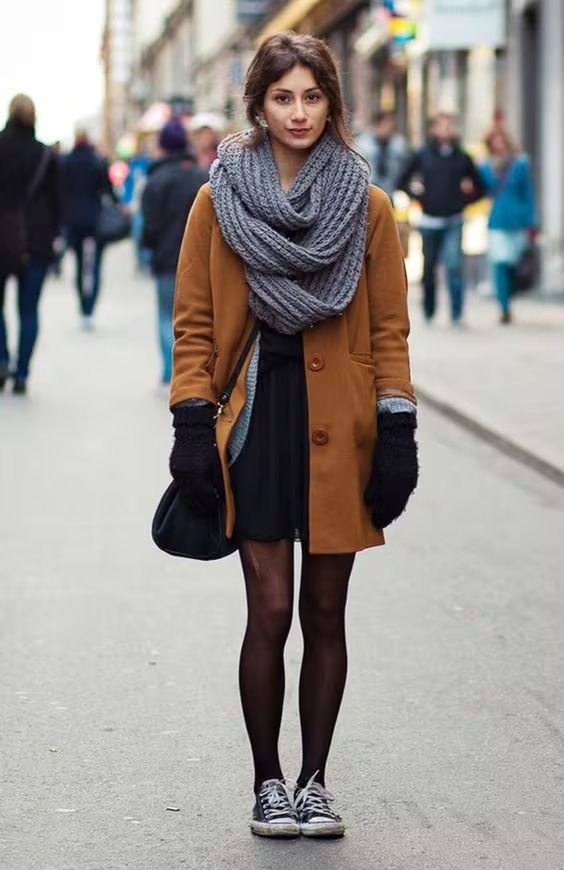
The first principle is the simplest and the most ignored: start thin and build up. The classic mistake is to begin with a thick sweater and then try to add more on top of it. The result is bulk at the shoulders, a coat that will not close, and sleeves that bunch at the elbows. The right approach is the opposite. Your base layer should be thin and close to the body — a fine merino wool crew neck, a thermal top, or a fitted long-sleeve T-shirt. Merino is the gold standard here: it is warm for its weight, it breathes, and it does not hold odour the way synthetic fabrics do. On top of that, a mid-layer adds the real insulation — a knit, a cardigan, a fleece or a light quilted vest. The outer layer, your coat, is then there to block wind and rain, not to do all the warming on its own. Three thin layers trap more warm air than one thick one, and they do it without the bulk.
The second principle is proportion. Layering only works when each layer is slightly larger than the one beneath it. A coat that fits perfectly over a T-shirt will not fit over a chunky knit, and forcing it will ruin the silhouette of both. When you buy a winter coat, try it on over the thickest thing you expect to wear underneath it. The shoulders should sit properly, the buttons should close without strain, and you should be able to raise your arms without the whole garment riding up. The same logic applies downwards: a long coat over a long sweater works, but a short jacket over a long, untucked knit creates a messy line at the waist. Think of your outfit as a series of visible edges — collar, cuffs, hem — and make sure each one is deliberate. A shirt collar peeking above a knit, a cuff showing at the wrist, a hem that ends cleanly: these small details are what make layered outfits look intentional rather than accidental.
The third principle is texture. Winter is the season when fabric matters most, and layering gives you the chance to play with it. Wool, cashmere, corduroy, denim, leather and quilted nylon all behave differently, and combining them is what gives a winter outfit depth. A smooth leather jacket over a soft knit, a rough tweed coat over a fine shirt, a silk scarf against a wool coat — these contrasts are what the eye reads as interesting. The rule is to mix no more than two or three textures in one outfit, and to keep the colours calm while the textures do the talking. A charcoal coat, a navy knit and a grey scarf in three different fabrics will look richer than the same outfit in a single material, even though the colours are almost identical.
Colour, in fact, is the fourth principle, and winter is the season when most people get it wrong by playing it too safe. Black, grey and navy dominate cold-weather wardrobes for good reason — they are practical, they hide dirt, and they match everything. But an all-black layered outfit can look flat, because without colour contrast, the layers disappear into each other. The solution is not to wear bright colours. It is to use shade and tone: a camel coat over a chocolate knit, an olive scarf against a navy coat, a cream roll-neck under a charcoal jacket. These combinations are still muted and still practical, but they let each layer be seen. If you want one accent, make it the scarf — it sits near your face, it is easy to change, and it is the cheapest way to transform an outfit.
The fifth principle is the one that makes layering practical rather than merely decorative: you must be able to take layers off. Winter days are not uniformly cold. You walk from a freezing street into a heated train, from the train into a warm office, from the office out into the wind again. An outfit that only works when every layer is on is an outfit that will make you sweat indoors and freeze outdoors. The solution is to make your mid-layer something you would be happy to be seen in on its own — a good knit, a smart overshirt, a clean shirt — so that removing your coat does not feel like undressing. And your outer layer should be easy to carry: a coat that folds over your arm without looking like a burden, a scarf that fits in a bag. The best-layered people you see on the street are not the ones wearing the most clothes. They are the ones who look comfortable in every temperature, because their outfit was designed to adapt.
There are a few practical details worth knowing. Scarves should be long enough to wrap twice around the neck, with the ends tucked into the coat rather than flapping in the wind. Gloves should be thin enough to use your phone — or buy a pair with touchscreen fingertips, which are now widely available and inexpensive. A hat should cover your ears without crushing your hair, and a beanie in a neutral colour goes with almost everything. Boots should be waterproof, with a sole that grips on ice, because the most stylish winter outfit in the world is ruined by slipping on a pavement. And whatever you wear, check yourself in a mirror before you leave: sit down, stand up, put your coat on and take it off. If something bunches, pulls or rides up, fix it now, not on the street.
Finally, layering is a skill that rewards a small investment. You do not need a new wardrobe. You need a good base layer, one versatile mid-layer, one coat that fits properly over both, and a scarf you actually like. With those four things, you can build a dozen different outfits by swapping colours and textures. Winter lasts for months in most of the world, and it is the season when people spend the most time outdoors in their clothes. Learning to layer well is not a luxury. It is the difference between enduring the cold and enjoying it — between a season you survive and a season you look good in.