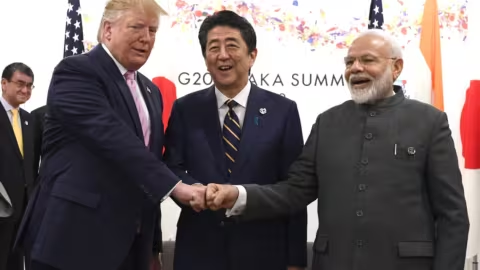
On Tuesday, 17 November 2026, in a meeting room in Manila, four leaders sat down together for the first time in more than two years — and the grouping they lead, the Quadrilateral Security Dialogue, came back to life. Donald Trump of the United States, Narendra Modi of India, Sanae Takaichi of Japan and Anthony Albanese of Australia met on the sidelines of the ASEAN summit in the Philippine capital, in what was Trump’s first in-person Quad leaders’ meeting since returning to the White House in January 2025. The meeting was short, and by most accounts it did not extend much beyond pleasantries. But its significance was not in what was said. It was in the fact that it happened at all — and in what it revealed about the new geopolitics of Asia.
The Quad has always been an awkward grouping. It is not a treaty alliance, it has no headquarters and no secretariat, and its members have often disagreed about what it is for. Broadly, it is aimed at counterbalancing China’s growing influence in the Indo-Pacific, and it brings together the region’s four major democracies in a loose partnership of security cooperation, infrastructure investment and technology coordination. But the grouping has been written off many times, and never more so than in the past two years. Trump, since returning to power, has focused on stabilising ties with China, and many observers questioned whether he still saw any value in a grouping whose purpose is, in large part, to counter Beijing. The leaders’ summit that India was supposed to host never happened. Foreign ministers met — three times in 2026, including a meeting in New Delhi in May — but the leaders themselves did not. Until Tuesday.
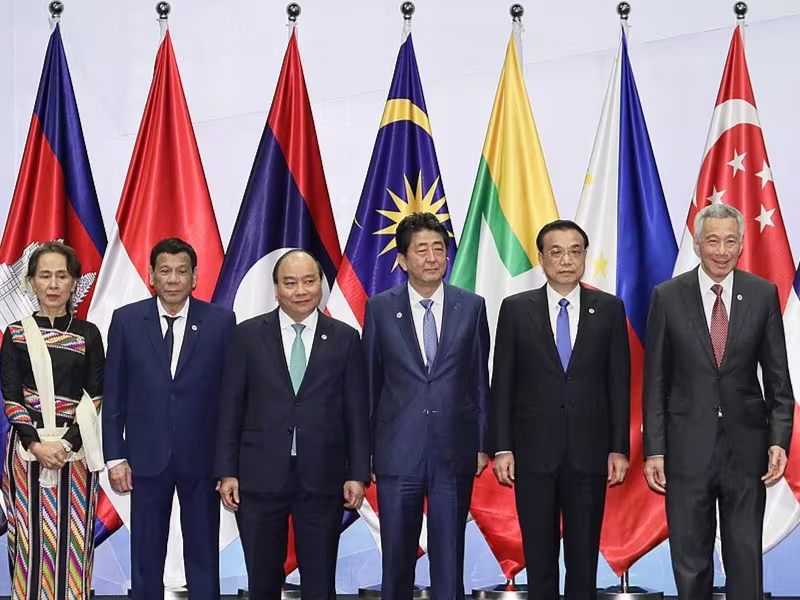
The Manila meeting was, in part, a piece of stagecraft. Trump was greeted at the airport by a marching band and an honour guard, and elsewhere in the city about 2,000 demonstrators faced off with police, carrying banners against the American presence. The contrast captured the contradictions of the visit: a president welcomed as a partner by the region’s governments and protested as an imperialist by its streets. Inside the meeting room, the four leaders posed for photographs and discussed what the White House described as shared interests of peace, prosperity and security in the Indo-Pacific. Analysts were more sceptical, noting that the short time allotted for the meeting meant it was unlikely to extend beyond pleasantries. But even pleasantries matter when they are exchanged by the leaders of the world’s largest economy, its most populous country, its most technologically advanced island nation and its most strategically positioned continent.
The substance of the Quad’s agenda, to the extent it exists, is increasingly about technology. The United States is pushing its Pax Silica initiative — a plan to build a complete mine-to-chip supply chain, from raw materials to finished semiconductors, outside China’s control. The initiative is aimed at countering China’s dominance in semiconductors and rare earths, and it has been the focus of months of protests in the Philippines, where its flagship project, a 1,620-hectare AI manufacturing hub north of Manila, threatens to displace Indigenous families. The hub is the physical embodiment of the new geopolitics: a vast industrial complex, built on contested land, designed to produce the chips that will power the artificial intelligence systems of the next decade. The protesters in Manila understood what was at stake. The question is whether the leaders in the meeting room did too.
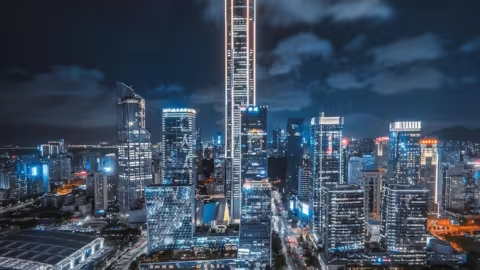
The timing of the Quad meeting, two days before Trump’s trilateral with Xi Jinping and Vladimir Putin in Shenzhen, was no accident. The four leaders in Manila were, in effect, briefing the American president before he sat down with the Chinese and Russian leaders — giving him their assessment of China’s growing military and maritime activities in the Indo-Pacific, and reminding him that the region’s democracies expect to be consulted before deals are struck over their heads. India, Japan and Australia all have their own reasons to be wary of Beijing, and the Quad meeting was their opportunity to make that case directly. Whether Trump listened is another question. He has sent mixed signals about his approach to China throughout his second term, alternating between confrontation and accommodation, and the Quad’s members have learned to hedge their bets.
The wider summit week in Manila underscored how crowded Asia’s diplomatic calendar has become. Five major meetings took place in five days: the 49th ASEAN Summit from 15 to 17 November, bringing together the leaders of the 11-nation bloc; the 21st East Asia Summit on 17 November; the Quad leaders’ meeting on the same day; the APEC summit in Shenzhen from 18 to 19 November; and the first-ever trilateral between Trump, Xi and Putin on 19 November. The sheer density of the schedule is itself a statement about where the world’s centre of gravity now lies. The great questions of the decade — war and peace, trade and technology, energy and climate — are being decided in Asian cities, in meetings that overlap and interlock, by leaders who fly from one summit to the next in the space of a single week.
The Quad’s future remains uncertain. The grouping has no treaty, no army and no budget, and its members have different interests, different histories and different relationships with China. What it has is a shared conviction that the Indo-Pacific should remain free and open, and a shared anxiety about what happens if it does not. The Manila meeting did not resolve that anxiety, and it did not produce a new strategy. But it did something that matters in diplomacy: it showed that the four leaders are still willing to sit in the same room, still willing to be photographed together, and still willing to call themselves partners. In a week when the world’s three great powers met in Shenzhen to discuss wars and weapons, that may seem like a small thing. It is not. The Quad is the counterweight to the trilateral, the reminder that the future of Asia will not be decided by three men in a room — and that the region’s democracies intend to have a say in it.
Sources: Firstpost, November 2026; Channel News Asia, 18 November 2026; The Financial Express, November 2026; Daily Pioneer, November 2026; Chosun Biz, 14 November 2026.